Airy Persiflage
Science

Comments (0)

Permalink

That, Nobody Asks

Via Corpus Callosum, here’s another way to handle uncertainty:

And the child asked:

Q: Where did this rock come from?
A: I chipped it off the big boulder, at the center of the village.
Q: Where did the boulder come from?
A: It probably rolled off the huge mountain that towers over our village.
Q: Where did the mountain come from?
A: The same place as all stone: it is the bones of Ymir, the primordial giant.
Q: Where did the primordial giant, Ymir, come from?
A: From the great abyss, Ginnungagap.
Q: Where did the great abyss, Ginnungagap, come from?
A: Never ask that question.

The author says we have lots of “semantic stopsigns,” signalling “do not think beyond this point.”

The stopsigns are up wherever the questions start to get hard. That’s where the most interesting answers lurk.

It’s not just the usual suspects that signal “no thinking”:

I know someone whose answer to every one of these questions is “Liberal democracy!” That’s it. That’s his answer. If you ask the obvious question of “How well have liberal democracies performed, historically, on problems this tricky?” or “What if liberal democracy does something stupid?” then you’re an autocrat, or libertopian, or otherwise a very very bad person. No one is allowed to question democracy.

I once called this kind of thinking “the divine right of democracy”. But it is more precise to say that “Democracy!” functioned for him as a semantic stopsign. If anyone had said to him “Turn it over to the Coca-Cola corporation!”, he would have asked the obvious next questions: “Why? What will the Coca-Cola corporation do about it? Why should we trust them? Have they done well in the past on equally tricky problems?”

The problem with blind faith — no matter what it is we believe in — is that we don’t even realize where we’ve stopped thinking. We’re blind to our own blind spots.

Airy Persiflage
Politics

Comments (1)

Permalink

Giddyup

Eolake Stobblehouse considers the dead horse problem:

Dakota Native American tribal wisdom, passed on from generation to generation, says:

“When you discover that you are riding a dead horse, the best strategy is to dismount and get a different horse.”

Governments, he says, employ “more modern strategies,” including:

Buying a stronger whip. …

Appointing a committee to study the horse. …

Lowering the standards so that the dead horse can be included. …

Harnessing several dead horses together to increase speed. …

Providing additional funding and / or training to increase dead horse’s performance. …

Rewriting the expected performance requirements for all horses.

This reminds me of something, but I can’t quite put my finger on it…

Science

Comments (0)

Permalink

That, Nobody Knows

Physicist Richard Feynman tells how his father taught him “the difference between knowing the name of something, and knowing something.”

The general principle is that things that are moving try to keep on moving, and things that are standing still tend to stand still, unless you push on them hard. This tendency is called “inertia,” but nobody knows why it’s true.

Politics

Comments (3)

Permalink

Craig’s De-Listing

Many prominent Republicans are calling on a fellow Republican, Idaho Sen. Larry Craig, to resign. Craig’s seat has been considered a safe GOP seat for years, but Republican strategists worry the party might lose the seat next year if they put a candidate tainted with hypocrisy and scandal on the ballot.

I think they’re making a serious mistake. Where is the modern Republican Party going to find a candidate untainted by hypocrisy and scandal?

And with Larry Craig out of the Senate, who will push for the Congressional investigation we need: How many undercover cops do we have lurking in public restrooms, trying to ruin some gay guy? Is this our best use of law-enforcement resources?

Politics

Comments (0)

Permalink

America in Ruins, New Orleans-Style

Look, no hurricanes todayGeorge W. Bush went to New Orleans today for a number of photo-ops as part of the “America in Ruins” tour. Bush marked the second anniversary of Hurricane Katrina hitting the city with two minutes of silence and two years of neglect.

(Okay, I made up the “two minutes of silence” thing.)

Update: Cartoonist Mike Luckovich says Bush brought a hopeful message to New Orleans.

Politics

Comments (0)

Permalink

Sure to Go to Heaven

I’m sure to go to Heaven
‘Cause I’ve done my time in Hell

Bush League Mitt Romney knows there’s more than one way to serve your country, and Fox News plays its part to get the vital message out:

Aasif Mandvi on life on the front lines — the Home Front:

Politics

Comments (1)

Permalink

“Bush League” Mitt

Ever since Mitt Romney joined in attacking Barack Obama for saying, “If we have actionable intelligence about high-value terrorist targets, and President Musharraf will not act, we will,” I’ve been trying to think up a descriptive nickname for ol’ Mitt.

But I’m in a rut. Maybe because his name reminds me of, say, a catcher’s mitt, all my ideas seem to have some sort of baseball theme.

I thought of Mitt “The Ump” Romney, because he’s declared al Qaeda Safe! Safe! in Pakistan, unless President Musharraf takes them out. But it’s not a good nickname, because an ump also calls strikes, and Mitt won’t do that.

I thought of “Miss Mitt” Romney, as in “a swing and a miss,” but Mitt won’t take a swing. That led me to “Checked Swing” Mitt Romney, but a checked swing usually indicates a sharp hitter laying off a bad pitch. Swinging on a good pitch only with a signal from some guy in the stands — that’s a different kind of thing.

Right now I’m thinking “Bush League” Mitt Romney.

Mitt is the guy who said he didn’t want to close Gitmo, he wanted to double it. If he’s not going after al Qaeda leadership, who’s he planning to put down there? People who make fun of him, I’ll bet.

Bush League. Yeah.

Politics

Comments (0)

Permalink

Presidential Resignation Day

Thirty-three years ago today, Richard M. Nixon announced that he would resign as President of the United States. He left office the following day.

In a comment from last month, Keith Olbermann asked Bush and Cheney to follow Nixon’s example.

Politics

Comments (0)

Permalink

Pushovers

In his inaugural address, John F. Kennedy said, “Let us never negotiate out of fear, but let us never fear to negotiate.”

Nowadays a lot of politicans of both parties seem utterly terrified at the idea of sitting down with people we don’t agree with.

I guess they’re afraid that when they sat down with Fidel Castro, for example, they would instantly be powerless to say anything but “Yes, master! What is your bidding?”

Really, if those politicians are such pushovers, I don’t want them negotiating with our friends, let alone our enemies. Get ’em out of politics altogether, I say.

Politics

Comments (0)

Permalink

Rubber-Stamp Democrats

The right of the people to be secure in their persons, houses, papers, and effects, against unreasonable searches and seizures, shall not be violated, and no Warrants shall issue, but upon probable cause, supported by Oath or affirmation, and particularly describing the place to be searched, and the persons or things to be seized. —The Fourth Amendment to the U.S. Constitution

Last year I complained a lot about the “Rubber-Stamp Republicans” in Congress who could never say no to George W. Bush or Dick Cheney, even if it meant trampling on the Constitution.

Well, let me take a moment to recognize all the Republicans in Congress who voted against granting new powers of warrantless wiretapping to the Attorney General:

Rep. Tim Johnson, of Illinois, and Rep. Walter Jones, of North Carolina.

That’s it.

Not one Republican Senator voted against the bill. These two were the only Republicans in the House who voted against it. Thank you, gentlemen.

There were nine other Republicans in the House of Representatives who didn’t cast a vote on the issue, including Republican presidential candidates Duncan Hunter, Ron Paul and Tom Tancredo. Six Republican Senators didn’t vote on the issue, including Republican presidential candidate John McCain. I don’t know whether those members abstained out of respect for the Constitution, or for some other reason. I know they were missing when the Constitution needed friends to “preserve, protect and defend” it.

But I’ve said enough about Rubber-Stamp Republicans. My anger now is for Rubber-Stamp Democrats — sixteen in the Senate, forty-one in the House — who voted to give a new blank check to George W. Bush and Alberto Gonzales.

From the House of Representatives:

Jason Altmire, John Barrow, Melissa Bean, Dan Boren, Leonard Boswell, Allen Boyd, Christopher Carney, Ben Chandler, Jim Cooper, Jim Costa, Bud Cramer, Henry Cuellar, Lincoln Davis, Artur Davis, Joe Donnelly, Chet Edwards, Brad Ellsworth, Bob Etheridge, Bart Gordon, Brian Higgins, Baron Hill, Nicholas Lampson, Daniel Lipinski, Jim Marshall, Jim Matheson, Mike McIntyre, Charles Melancon, Harry Mitchell, Collin Peterson, Earl Pomeroy, Ciro Rodriguez, Mike Ross, John Salazar, Stephanie Herseth Sandlin, Heath Shuler, Vic Snyder, Zachary Space, John Tanner, Gene Taylor, Timothy Walz, Charles Wilson.

From the Senate:

Evan Bayh, Thomas Carper, Bob Casey, Kent Conrad, Dianne Feinstein, Daniel Inouye, Amy Klobuchar, Mary Landrieu, Blanche Lincoln, Claire McCaskill, Barbara Mikulski, Ben Nelson, Bill Nelson, Mark Pryor, Kenneth Salazar, Jim Webb.

It’s a Hall of Shame.

Politics

Comments (1)

Permalink

Who’s Naive?

During the YouTube debate a few weeks ago, Barack Obama said that, yes, he would be willing to meet with the leaders of so-called “rogue nations.”

Well, that got Hillary Clinton jumping up and down, and soon she was joined by other Democratic candidates, then by some pundits, then by some Republican presidential candidates — all jumping up and down, all claiming that Obama was inexperienced, foolish, and naive.

You see, for more than fifty years, through Republican administrations and Democratic administrations, it has been the policy of the United States to turn a diplomatic cold shoulder to North Korea. For nearly fifty years, we have applied the same bi-partisan policy to Fidel Castro’s Cuba. For almost thirty years, we’ve given the same cold shoulder to Iran. (Well, except for selling them weapons during the Reagan Administration and using the profits to undermine the democratically-elected government of Nicaragua.)

How has this policy worked out? Well, Kim Jong Il remains firmly entrenched in North Korea, having recently test fired his first nuclear weapons. Fidel Castro is still in charge in Cuba, threatened more by old age than American disapproval. And Iran is still racing to develop their own nuclear weapons and permanently shift the balance of power in the Middle East.

Who’s foolish? Who’s naive?

In a speech last week, Obama said:

If we have actionable intelligence about high-value terrorist targets, and President Musharraf will not act, we will.

Then, in a radio interview, Obama let it slip that he wouldn’t use nuclear weapons against terrorists hiding among civilians.

Once again, Obama’s critics jumped up and down and said he was inexperienced and foolish and naive. How dare he rule out nuclear weapons? The nukes, and the possibility that we’ll use them on a whim, are why we’re feared around the world. If they’re also part of why we’re hated around the world, well, that’s the price you pay for fifty years and more of highly sophisticated strategic thinking, that’s all.

Republican candidate Mitt Romney said:

I had to laugh at what I saw Barack Obama do. I mean, in one week he went from saying he’s gonna sit down for tea with our enemies, but then he’s gonna bomb our allies. I mean, he’s gone from Jane Fonda to Dr. Strangelove.

That’s tellin’ him, Mitt! That’s the way to play to the base! And we’ll keep reminding the American people that you, an experienced, wise and sophisticated person, will never act against al Qaeda without getting Musharraf’s permission first.

Sorry, Hillary. Sorry, Mitt. Sorry, all you sophisticated candidates and pundits. I’m going with the naive guy. He makes more sense than all the rest of you put together.

Politics

Comments (0)

Permalink

America in Ruins, Again

AmericaInRuins.jpgGeorge W. Bush mugs for the cameras in front of the wreckage of a collapsed highway bridge in Minneapolis. Bush’s visit to the site, days after the White House declared the collapse a “state responsibility,” was the latest in a series of “America in Ruins” photo-ops that have become the hallmark of his presidency.

Science

Comments (0)

Permalink

Moon Day

When the first live television pictures from the surface of the moon appeared on our TV screens thirty-eight years ago tonight, they were gray and grainy and, for a moment, upside down.

Even when that technical glitch was fixed, and the black-and-white picture was right-side up, the images were difficult to understand. The television networks had shown us ground-based simulations of the first moon walk, but they never showed us astronauts with reflective visors that prevented us from seeing their faces, and they never showed the lower stage of the lunar module wrapped in a protective covering that looked like gold foil, so nothing looked familiar in the pictures coming from the moon.

Bright objects burned their images into the camera’s video tube: when Neil Armstrong or Buzz Aldrin walked across the moonscape, the burned-in background seemed to show right through the astronaut’s ghostly body.

That first moon walk lasted about two hours. Baffling as the video images were, I watched every minute of it, and only wished that I could better understand what I was seeing.

So I was thrilled, a few years ago, when a company called Spacecraft Films started to release multi-DVD collections with all the video and motion-picture film from the Apollo lunar missions. The Apollo 11 set includes three video options for the first moon walk: the video, just as it was originally broadcast, a slide show of still photos synced to the time each photo was taken, and a combination mode in which the video plays with the still photos showing up in little on-screen boxes. This third mode made it much easier for me to understand just what was happening throughout the entire time on the surface.

The Spacecraft Films videos are tailored for real space nuts. They don’t provide much “hand-holding.” They don’t explain the cryptic jargon used by the astronauts or the ground controllers; they just let us watch as events play out. But, particularly if you can borrow them from your local library, I highly recommend these video collections.

If you’re a real space nut, you will probably want to supplement the videos with the NASA Mission Reports published by Apogee Books, or go explore the Apollo Lunar Surface Journal and the Apollo Image Gallery.

And if you really want to capture what it felt like to watch men walk on the moon for the first time, thirty-eight years ago tonight, you can stand on your head, squint, and view the pictures upside-down.

Funnies
Politics

Comments (0)

Permalink

Secret Origins of U.S. Policy

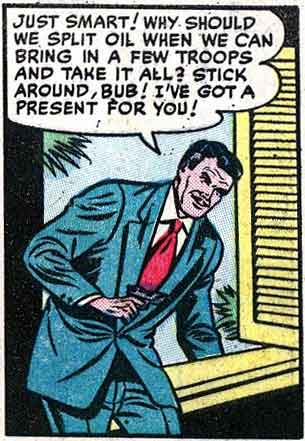
Cheney Role ModelOver at Boing Boing, Jay Kinney shows us a page from a 1952 comic book that predicts today’s Bush-Cheney mideast policies.

It was all there in T-Man #3, 55 years ago! Perhaps Cheney read this comic in his youth and just bided his time until he was in a position to actualize it in real life.

Let me guess — when Cheney was young, the kids used to call him Mr. Glass.

Music

Comments (23)

Permalink

Master Jack

It was supposed to be an Instant Cultural Touchstone.

When I quoted a line from the 1968 pop song “Master Jack” a while ago — “It’s a strange, strange world we live in, Master Jack” — I was convinced that anyone who read it would immediately have that song running through his head.

I was wrong.

I’ve talked to a few people — people old enough to remember 1968 pop songs — and it seems I can’t tell an Instant Cultural Touchstone from History’s Most Baffling Trivia. Darn.

Here is an old music video of the South African group Four Jacks and a Jill performing “Master Jack.” Pay no attention to the very poor lip sync.